
Results of the Flexible Society Project-FSPJ, which promotes the use of wireless communications at various sites, including manufacturing sites (1)
The Flexible Society Project (FSPJ) is one of the projects of the National Institute of Information and Communications Technology (NICT), which conducts various activities to promote the utilization of wireless communication technology in the real world. FSPJ is one of the projects of the National Institute of Information and Communications Technology (NICT).
2025/11/18
Posted on 2025/11/18
Introduction.
The Flexible Society Project (FSPJ) is one of the projects of the National Institute of Information and Communications Technology (NICT), which conducts various activities to promote the utilization of wireless communication technologies in the real world. Starting with this issue, we will introduce some of the results obtained through FSPJ activities in a series of articles on XGMF's "TeleGraphic," which supports industrial transformation through wireless communications (IX). In this first installment, we will first explain the background and objectives of FSPJ, as well as its activities and achievements to date.
Background of FSPJ
Wireless communication technology is an important component of advanced information and communication technology (ICT) applications, such as the introduction of cyber-physical systems (CPS) and the realization of digital transformation (DX) in various fields, and its use has been expanding rapidly in recent years. Wireless communication enables data acquisition and transmission of commands using electromagnetic waves without using cables, etc., thereby reducing the costs associated with wiring and realizing new added value such as the introduction of mobile devices.
On the other hand, as the use of wireless communications advances, there have been reports of cases where problems specific to wireless communications have occurred due to the instability of wireless communications caused by the characteristics of electromagnetic waves and other factors. Many of these problems can be resolved by taking appropriate measures based on expert knowledge of wireless communications. However, due to lack of expertise, there have been some cases of excessive reactions, such as abandoning the introduction of wireless communication due to excessive fear of problems occurring, which may be a disincentive to further expansion of the utilization of wireless communication.
Purpose of FSPJ
FSPJ aims to realize workplaces where people engaged in work can work smoothly and with peace of mind through the appropriate use of wireless communication technology at workplaces in various fields in the real world, including manufacturing, logistics, medical care, and social infrastructure. To achieve this goal, we are working on (1) understanding the actual situation regarding the use of wireless communications in the field, (2) organizing and sharing knowledge to properly demonstrate the capabilities of wireless communications in the field, and (3) research and development of technologies to enable the appropriate use of wireless communications without advanced expertise. We are working on (3) research and development of technology to enable appropriate utilization of wireless communications without advanced expertise.
FSPJ Activities to Date
The starting point of FSPJ activities dates back 10 years ago. In March 2015, an experiment was conducted at an actual manufacturing site to understand the actual situation regarding the use of wireless communication at the manufacturing site. In March 2015, an actual on-site experiment was conducted to understand the actual situation regarding the use of wireless communication in manufacturing.
In June of the same year, the Flexible Factory Project (FFPJ), the predecessor of the FSPJ, was launched at NICT with members from several companies participating as cooperative researchers. The FFPJ has (1) conducted experiments to evaluate wireless communication performance at various manufacturing sites, (2) prepared documents based on the knowledge and experience of its members and the findings obtained through on-site experiments, and (3) proposed stabilization technologies for wireless communication inspired by the on-site activities of experts with advanced expertise. FFPJ began its activities primarily targeting manufacturing sites, but as we proceeded with our efforts, we were increasingly approached for consultation on interesting issues related to wireless communications, such as similar problems at other sites and concerns about using data for purposes and purposes that go beyond the intended use of the data.
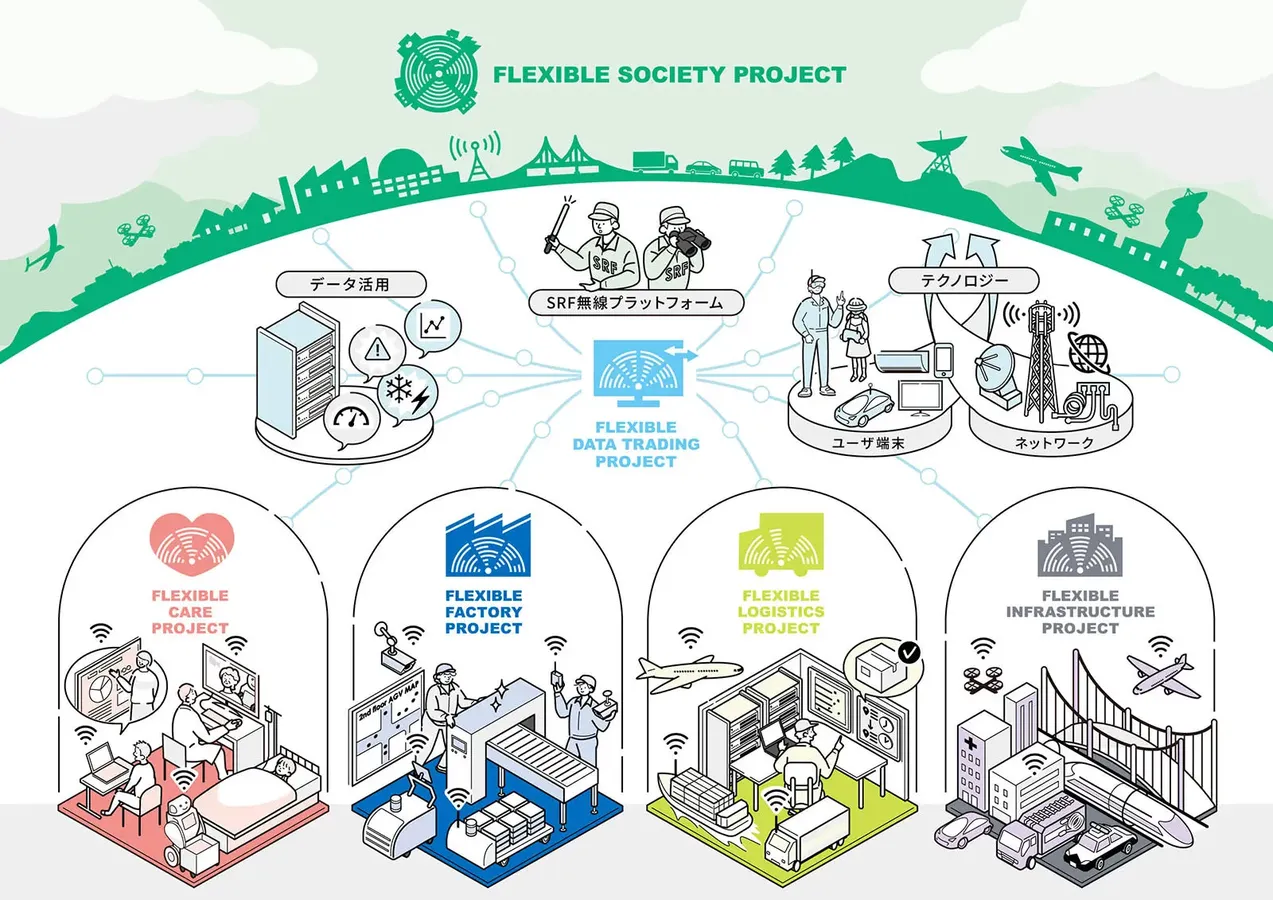
In parallel with FFPJ, the Flexible Logistics Project (FLPJ) targets logistics sites, the Flexible Care Project (FCPJ) targets healthcare and education sites, the Flexible Infrastructure Project (FIPJ) targets social infrastructure, and the Flexible Data Trading Project (FDTPJ) targets the use of data across purposes and applications in different sites, starting in April 2020. Flexible Infrastructure Project (FIPJ), which targets social infrastructure, and the Flexible Data Trading Project (FDTPJ), which targets the use of data across purposes and applications at different sites. As a result, FFPJ, which targets manufacturing sites, has evolved into FSPJ, which includes five subprojects: FFPJ, FLPJ, FCPJ, FIPJ, and FTPJ. The relationship between FSPJ and its five subprojects is shown in Figure 1.
Figure 1: FSPJ and its five subprojects
FSPJ Accomplishments
(1) Grasping the actual situation regarding the utilization of wireless communications in the field
FSPJ has conducted experiments such as performance evaluation on wireless communication at several sites every year, mainly at FFPJ. The data obtained as a result of these experiments include, for example, floor maps and photographs of actual manufacturing sites, which should be treated as confidential information at the sites that cooperated in the experiments. Therefore, in principle, detailed data is shared only within each project on a limited basis. However, some data are disclosed in the form of press releases, papers, etc., with the approval of the parties involved.
Examples of publicly available information can be found here:
- NICT, "NICT, NEC, Tohoku University, and Toyota Motor East Japan Successfully Demonstrate SRF Wireless Platform Ver. 2 at a Plant in Tohoku," Press Release, November 7, 2024.
- F. Ohori, S. Itaya, T. Osuga and T. Matsumura, "Evaluation of Productivity and Wireless Channel Load for 3D Storage System in Smart Factory," in IEEE Access, vol. 12, pp. 156549-156560, 2024, doi: 10.1109/ACCESS.2024.3486253.
- NICT, "Successful Demonstration of a New Evaluation Method for Stabilizing Wireless Communications in Factories," Press Release, March 16, 2022.
- S. Itaya, A. Amagai, T. Nakajima, F. Ohori, T. Osuga and T. Matsumura, "Status Monitoring and Diagnostics using Sensing Data in Flexible Factory," 2021 24th International Symposium on Wireless Personal Multimedia Communications (WPMC), Okayama, Japan, 2021, pp. 1-5, doi: 10.1109/WPMC52694. 2021.9700463.
- T. Osuga, T. Nakajima, S. Itaya and T. Matsumura, "Wireless Capacity Calculation Method for Manufacturing Tools," 2021 24th International Symposium on Wireless Personal Multimedia Communications (WPMC), Okayama, Japan, 2021, pp. 1-5, doi: 10.1109/WPMC52694. 2021.9700465.
- NICT, "Successful experiments with stabilization technology for wireless systems supporting manufacturing sites," Press Release, November 25, 2020.
- NICT, "Strong support for stable wireless communications at manufacturing sites," Press Release, October 10, 2019.
- ICT, "Verification of wireless communication technology across industry boundaries at a major factory in operation for factory IoT," Press Release, January 17, 2017.
(2) Organize and share knowledge, etc. to properly demonstrate the capabilities of wireless communications in the field
FSPJ organizes the FFPJ in a way that organizes the knowledge and experience possessed by its members and the findings obtained through experiments in the field,Documents have been prepared and publishedThe following is a list of the most common problems with the
In addition to the above public materials, FSPJ also publishes classroom training texts for the Wireless IoT Training Seminar for Factories. The Wireless IoT Training Course for Factories was held as part of the "ICT Human Resource Development Project for Appropriate Use of Radio Wave Utilization Systems for IoT Devices, etc." funded by the Ministry of Internal Affairs and Communications (MIC) through radio wave usage fees. FSPJ cooperated with the project in FY 2018 and FY 2019, conducting classroom lectures and hands-on training. Subsequently, in 2022, the course was updated to reflect the latest information at that time.Textbooks for classroom training are available and open to the public.The following is a list of the most common problems with the
(3) Technology that enables appropriate use of wireless communications without advanced expertise.
In January 2017, FSPJ proposed the concept of the SRF radio platform and software configuration for its realization. In January 2017, we proposed the concept of the SRF wireless platform and the software configuration to realize it. Subsequently, we proceeded to clarify and implement the technical specifications, and in November 2020, we presented the results of actual field experiments. In March 2022, we also made a presentation on technologies related to evaluation methods for communication status in relation to stabilization of wireless communication.
In addition to the above R&D and other activities, FSPJ has been working on social implementation and promotion of the SRF platform; in July 2017, FSPJ established the Flexible Factory Partner Alliance (FFPA) with NICT and six other companies. Although FFPA and FFPJ are sometimes confused because of their similar names, they are independent entities despite their cooperative relationship: while FFPJ is one of NICT's internal projects, FFPA is a voluntary organization established outside and independent of NICT.
FFPA is leading the activities to develop specifications and promote the SRF platform initially proposed by FFPJ, and FFPA published the SRF Technical Specification Ver. 1.0 in September 2019, followed by a series of revisions, and in October 2023, the latest SRF Technical Specification Ver. The latest version, SRF Technical Specification Ver. 2.1, was published in October 2023. In January 2021, SRF Conformance Test Specification Ver. 1.0 was issued, and in October of the same year, SRF Interoperability Test Specification Ver. 1.0 was issued, which has been revised and updated since then. In December of the same year, the SRF certification program was launched, and in March 2023, four products were certified as the first product line compliant with SRF Technical Specification Ver. 1.1. Currently, 15 products have been certified and are ready for full-scale social implementation.
Conclusion
In this article, we have first described the background and purpose of the FSPJ and its activities and achievements to date, before introducing some of the results obtained through the activities of the FSPJ in a series of articles in TeleGraphic. In the next and subsequent articles in this series, we will introduce the FSPJ's public "Case Studies of Wireless Communication Troubleshooting at Manufacturing Sites"From the following pages, we will cite and introduce one case study at a time on actual problems related to wireless communications in the field and countermeasures to deal with them. Please stay tuned.
author
Network Research Laboratory, National Institute of Information and Communications Technology
Ryota Yamada, Cooperative Researcher
Cooperating Researcher Akihiro Amemi
Atsushi OZEKI, Cooperative Researcher
Naotaka Tomita, Cooperative Researcher
Jun Hasegawa, Cooperative Researcher
Research Scientist, Kenchi Nakajima
Senior Research Engineer Fumiko Ohori
Research Director Satoko Itaya